I Need Help With My Environment.
If you're concerned about conditions in your home or building, PEPN helps you understand what a comprehensive environmental investigation should consider — and how to find qualified professionals who can help.
Across the country, millions are living with allergies, asthma, chronic sinus conditions, and more complex illnesses. Public-health authorities have now acknowledged that damp and water-damaged buildings are associated with a range of adverse health effects, and that biological material can accumulate in indoor dust and become re-aerosolized through normal human activity.
Doctors. Tests. Specialists. Online communities.
Families searching for explanations, sometimes for years,
as they try to understand whether their environment
may be contributing to their health concerns.
They've spent
tens of thousands of dollars,
sometimes more.
The work has been completed. Yet questions remain
about the environment in which they live.
Their physician may still be concerned about
ongoing exposure.
“My doctor says I may still be exposed in my home. I've already had environmental assessments and structural repairs. Can you help me?”
In the first 20 seconds, can you demonstrate that
you understand their concern?
More importantly, do you have the knowledge to
investigate what may still be affecting their
environment?
PEPN™ was created to bring people together in the search for answers.
PEPN™ connects environmental professionals, affected occupants, and healthcare providers through more than 40 years of environmental science and over 400 peer-reviewed and clinical publications — advancing a unified, science-aligned approach to understanding, reducing, and verifying environmental exposure.
PEPN™ is advancing a science-aligned framework for identifying, reducing, and verifying biologically relevant environmental exposure within the built environment.
To advance environmental health by transforming
how the built environment is understood—
moving beyond visible conditions and structural
correction to identify, measure, reduce, and verify
environmental exposure.
Through data, evidence, standards, and controls,
PEPN™ is establishing a more accountable standard
for the environments in which people
live, work, learn, and recover.
PEPN™ — the Purified Environments Provider Network — is a professional environmental health organization advancing a science-aligned approach to understanding, reducing, and verifying biologically relevant exposures within the built environment.
PEPN brings occupants, healthcare providers, and environmental professionals into a shared framework — while preserving the distinct role of each.
If you're concerned about conditions in your home or building, PEPN helps you understand what a comprehensive environmental investigation should consider — and how to find qualified professionals who can help.
PEPN provides healthcare professionals with a clearer understanding of the environmental investigation process, terminology, measurements, and verification methods used by trained environmental professionals.
PEPN supports environmental professionals who want to move beyond conventional inspection toward a structured, exposure-focused approach grounded in science, defined methods, verification, and professional accountability.
PEPN maintains a clear professional boundary: healthcare professionals evaluate and manage patients; environmental professionals investigate and manage buildings. PEPN helps create a common language between the two.
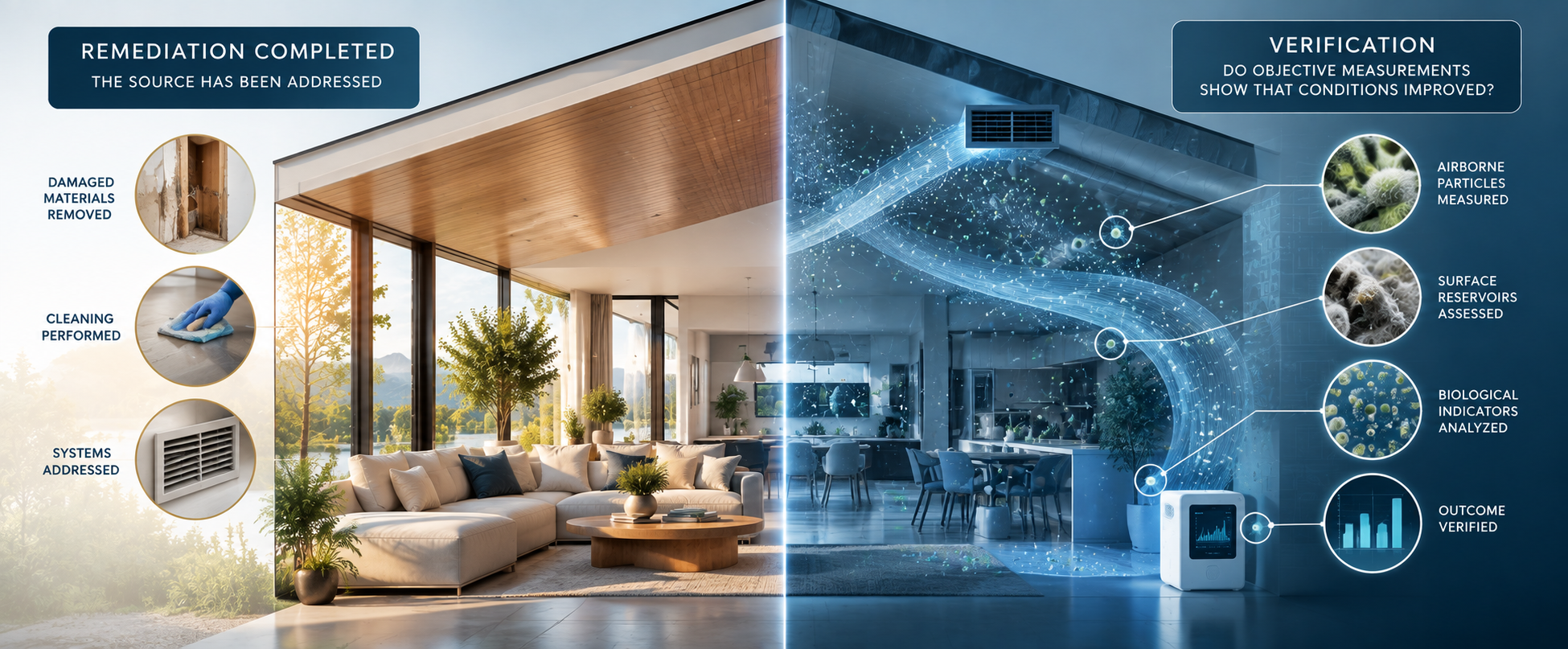
Finding a source and correcting damaged building materials are critical steps. But when environmental exposure is the concern, completing the work is not the same as demonstrating that the environment has measurably improved.
The question is no longer only, “Was the source corrected?” It is also, “What changed in the environment?”
Completion and verification answer different questions. Completing remediation documents that corrective work was performed. Environmental verification evaluates whether defined conditions changed following that intervention. Both are important — but they are not interchangeable.
PEPN-HEART™ connects environmental investigation, characterization, intervention, cleaning, verification, and stabilization into a continuous framework — so the process does not simply end when the work is complete.
PEPN-HEART™ provides a structured framework for moving from environmental investigation through intervention and objective verification — connecting each stage rather than treating them as isolated events.
The goal is not simply to identify a problem. The process continues until environmental conditions can be evaluated after intervention.
Investigate the building, occupant concerns, environmental conditions, moisture, HVAC systems and potential exposure pathways.
›Integrate observations, measurements and laboratory information to characterize sources, reservoirs and pathways.
›Define corrective actions directed toward identified environmental sources and building conditions.
›Address environmental reservoirs and residual contamination that may remain after source correction.
›Reproduce defined measurements where appropriate to determine whether environmental conditions improved following intervention.
›Support building conditions that reduce the likelihood of recurrence and maintain environmental improvements.
PEPN-HEART™ does not treat assessment, remediation, cleaning and verification as disconnected services. Information from each stage informs the next — and verification provides evidence for determining whether the environmental intervention achieved its intended outcome.
Evaluate how environmental sources and reservoirs may interact with occupied spaces rather than evaluating findings in isolation.
Where appropriate, repeat defined measurements after intervention so improvement can be evaluated objectively.
Environmental work should produce a documented record connecting observations, actions and verification.
Buildings are not investigated in isolation. They are the places where people live, work, learn, recover, and spend much of their lives. When environmental concerns arise, people need more than disconnected observations and laboratory results. They need a process that helps make environmental information understandable, actionable, and verifiable.
The building is the environment.
The person is the reason
the environment matters.
What environmental conditions are present in the building?
How could those conditions interact with occupied spaces?
Did intervention measurably improve those conditions?
PEPN-HEART™ draws from decades of published research across environmental health, indoor air quality, building science, microbiology, exposure science, aerosol science, and related disciplines. PEPN brings those bodies of knowledge together within a structured environmental framework.
Scientific literature supporting principles incorporated throughout the PEPN framework and educational materials.
Drawing from decades of research across environmental and building-related disciplines.
Multiple scientific fields brought together to examine the built environment.
Understanding environmental conditions and potential routes of human exposure.
Moisture, materials, pressure, ventilation and building-system interactions.
Biological organisms, fragments, reservoirs and environmental indicators.
Examining how environmental agents may move from sources toward occupied environments.
Understanding airborne particles, transport, filtration and deposition within buildings.
Ventilation, filtration, humidity and environmental conditions within occupied spaces.
An important distinction: PEPN-HEART™ is a professional environmental framework developed by PEPN. Individual scientific publications cited by PEPN support specific scientific principles and findings; their inclusion should not be interpreted as an endorsement of PEPN, PEPN-HEART™, or every element of the framework by the authors or institutions of those publications.
PEPN connects a science-aligned framework, professional education, certification, research collaboration, and professional governance into an integrated system designed to advance more consistent environmental investigation, intervention, and verification.
The Purified Environments Provider Network advances environmental health through science-aligned frameworks, professional education, collaboration, and accountability.
The structured environmental framework connecting investigation, characterization, intervention, cleaning, verification, and stabilization.
Professional education and certification for environmental practitioners trained in environmental exposure concepts and the PEPN biological exposure system.
The Governance Research Alliance supports the continued development of PEPN through professional collaboration, research review, framework refinement, implementation guidance, and professional accountability.
PEPN™ establishes the system. PEPN-HEART™ defines the framework. MICRO CEEP™ develops professional competency. The Governance Research Alliance supports research review, framework development, implementation, and professional accountability.
PEPN is designed to connect published scientific principles with defined environmental methods, professional education, objective verification, ongoing research review, and professional accountability.
Correcting a source is essential. But when the objective is reducing environmental exposure, the process should also ask whether measurable environmental conditions changed following intervention.
Do not simply document that work was completed. Document what changed.
Establish the environmental conditions, observations, measurements, and sampling design used to characterize the original environment.
Correct identified sources, building conditions, reservoirs, and relevant exposure pathways according to the defined scope.
Reproduce the original sampling or measurement design sufficiently, where appropriate, to permit meaningful comparison.
Compare post-intervention observations and measurements with the established environmental baseline.
Document the findings, limitations, remaining conditions, and whether defined environmental objectives were achieved.
Completion documentation addresses whether the defined corrective actions were performed.
Environmental verification asks a different question: whether defined environmental conditions measurably changed following intervention.
Post-intervention verification should reproduce the original environmental sampling and measurement design sufficiently, where appropriate, to permit meaningful comparison between pre-intervention and post-intervention conditions.
Environmental verification evaluates environmental conditions and the results of environmental intervention. It does not diagnose medical conditions, determine individual clinical outcomes, or establish that a building caused an occupant's symptoms.
PEPN professional education moves beyond isolated testing and inspection concepts toward a structured understanding of environmental exposure, building systems, intervention, and objective verification.
MICRO CEEP™ provides a professional certification pathway for environmental practitioners seeking advanced education in environmental exposure concepts and the PEPN biological exposure system.
The training connects building science, environmental investigation, biological exposure concepts, environmental intervention, and verification within a structured professional framework.
The curriculum is designed to help environmental professionals understand how individual findings fit within the larger environmental system.
Professional scope matters. MICRO CEEP™ education is focused on environmental investigation and environmental exposure concepts. Certification does not authorize medical diagnosis or treatment, nor does it replace professional licenses required by applicable state or local law.
Explore MICRO CEEP™ professional training and learn how PEPN-HEART™ connects environmental investigation, intervention, and verification.
Environmental concerns can become complicated quickly. The PEPN professional network helps connect occupants, healthcare professionals, and other stakeholders with environmental professionals working within a structured, exposure-focused approach.
PEPN brings environmental professionals into a common framework built around investigation, exposure pathways, intervention, verification, and professional communication.
A broader environmental approach considering building conditions, potential sources, reservoirs, systems, and exposure pathways.
Environmental observations, measurements, and sampling selected within a defined investigative framework.
Environmental findings presented in language occupants and other professionals can more readily understand.
Where appropriate, environmental conditions are reevaluated after intervention to determine what measurably changed.
Homeowners, tenants, and building occupants looking for environmental professionals who can investigate concerns within a structured environmental framework.
Clinicians seeking environmental professionals who can investigate buildings and communicate environmental findings while maintaining clear professional boundaries.
Professionals seeking collaboration, referral relationships, education, and connection with others working within the PEPN environmental framework.
Use the PEPN provider directory to identify participating environmental professionals and review their listed services, credentials, geographic service areas, and professional information.
PEPN directory participation does not replace professional licensing requirements. Services, qualifications, credentials, licenses, and scope of practice may vary by provider and jurisdiction. Users should independently evaluate whether a professional is appropriately qualified and licensed for the services required.
Better environmental decisions begin with understanding what is happening within the built environment, addressing the conditions that matter, and verifying whether intervention produced measurable change.
Connect with environmental professionals who understand building conditions, exposure pathways, environmental investigation, intervention, and verification.
Find a PEPN Professional ›Explore the environmental framework connecting assessment, characterization, intervention, cleaning, verification, and stabilization.
Explore PEPN-HEART™ ›Advance your understanding of environmental exposure concepts, the PEPN framework, and the MICRO CEEP™ professional certification pathway.
Explore Professional Training ›Identify what matters. Understand how it moves. Reduce the environmental burden. Verify what changed.